Google Ads Manual CPC vs Target CPA, 60/40 experiment: $416 vs $152 per lead (p=0.009)
On the afternoon of 24 August, someone opened a mid-sized Google Ads account and, in the space of ten minutes, changed the bid strategy on four battery campaigns from Maximise Conversions with a $200 target to Manual CPC. The next day a panel campaign followed. Eleven new campaigns were created that week, all on Manual CPC. Dozens of exact-match Target CPA campaigns were paused. The brand campaign was throttled to a single ad group. Every lead form extension link in the account was paused.
The change history reads like a demolition.
Time | Change |
|---|---|
24 Aug, 16:05–16:15 | Four battery campaigns: Max Conversions (tCPA $200) → Manual CPC |
24–25 Aug | Dozens of exact-match Target CPA campaigns paused |
24–25 Aug | 44 of 45 brand ad groups paused |
24–25 Aug | All 24 lead form extension links paused |
25 Aug, 13:22 | Main panel campaign: Target CPA $160 → Manual CPC |
25 Aug – 2 Sep | Eleven new campaigns created, all Manual CPC |
The stated rationale, as far as we could reconstruct it, was that the automated bidding had been "learning from the wrong conversions", which, as it happens, was true, and is covered elsewhere in this series. The response to that diagnosis was to remove the automation entirely and rebuild by hand.
What happened next
Nine days before the change against nine days after, every campaign in the account including the paused ones:
Window | Spend | Conversions | Cost per lead |
|---|---|---|---|
16–24 Aug (before) | $58,732 | 337 | $174 |
25 Aug – 2 Sep (after) | $72,197 | 193 | $374 |
Change | +$13,465 | −144 | +115% |
The account spent $13,465 more and produced 144 fewer leads. Cost per lead more than doubled.
By category, under Manual CPC:
Category | Spend (25 Aug – 2 Sep) | Conversions | Cost per lead |
|---|---|---|---|
Panel | $28,331 | 41.1 | $689 |
Battery | $28,036 | 63.5 | $442 |
Quotes | $4,711 | 8.4 | $561 |
For context, the account's lifetime blended cost per lead is $128, and its non-brand search figure is $152.
The confound
That before/after comparison is real, and it's damning, and it does not prove that Manual CPC caused it. Too much changed at once.
What changed 24–25 Aug | Could it explain the drop on its own? |
|---|---|
Bid strategy → Manual CPC | Yes |
Dozens of proven exact-match campaigns paused | Yes |
Brand ad groups throttled | Yes, brand was 30% of conversions |
Lead form extensions paused | Partly, lead form submits were ~8% of conversions |
Eleven new campaigns with no history | Yes, new campaigns underperform |
Any one of those could produce a large part of the effect. The restructure is a natural experiment with five simultaneous treatments and no control group. You can see that something went badly wrong. You cannot see which thing.
This is the central problem with restructures as a way of learning anything. They're expensive, they're irreversible in practice, and they don't isolate variables.
So we ran the actual experiment
One battery campaign, the highest-volume one. Control arm stayed on Manual CPC. Treatment arm went to Maximise Conversions with a $120 target. Sixty-forty split, control-heavy, because the campaign couldn't afford to lose more than it already had.
Control (Manual CPC) | Treatment (Max Conv, tCPA $120) | |
|---|---|---|
Traffic share | 60% | 40% |
Cost per lead, as reported | $277 | $82 |
z-statistic | 4.10 | |
p-value | 0.00004 |
That's a dramatic result and it's too dramatic: the account's conversion counting was inflated at the time, for reasons the previous post covers. So we recomputed with only the conversion actions we trusted: the GA4 web form, phone calls, and Google-hosted lead form submissions.
Control | Treatment | |
|---|---|---|
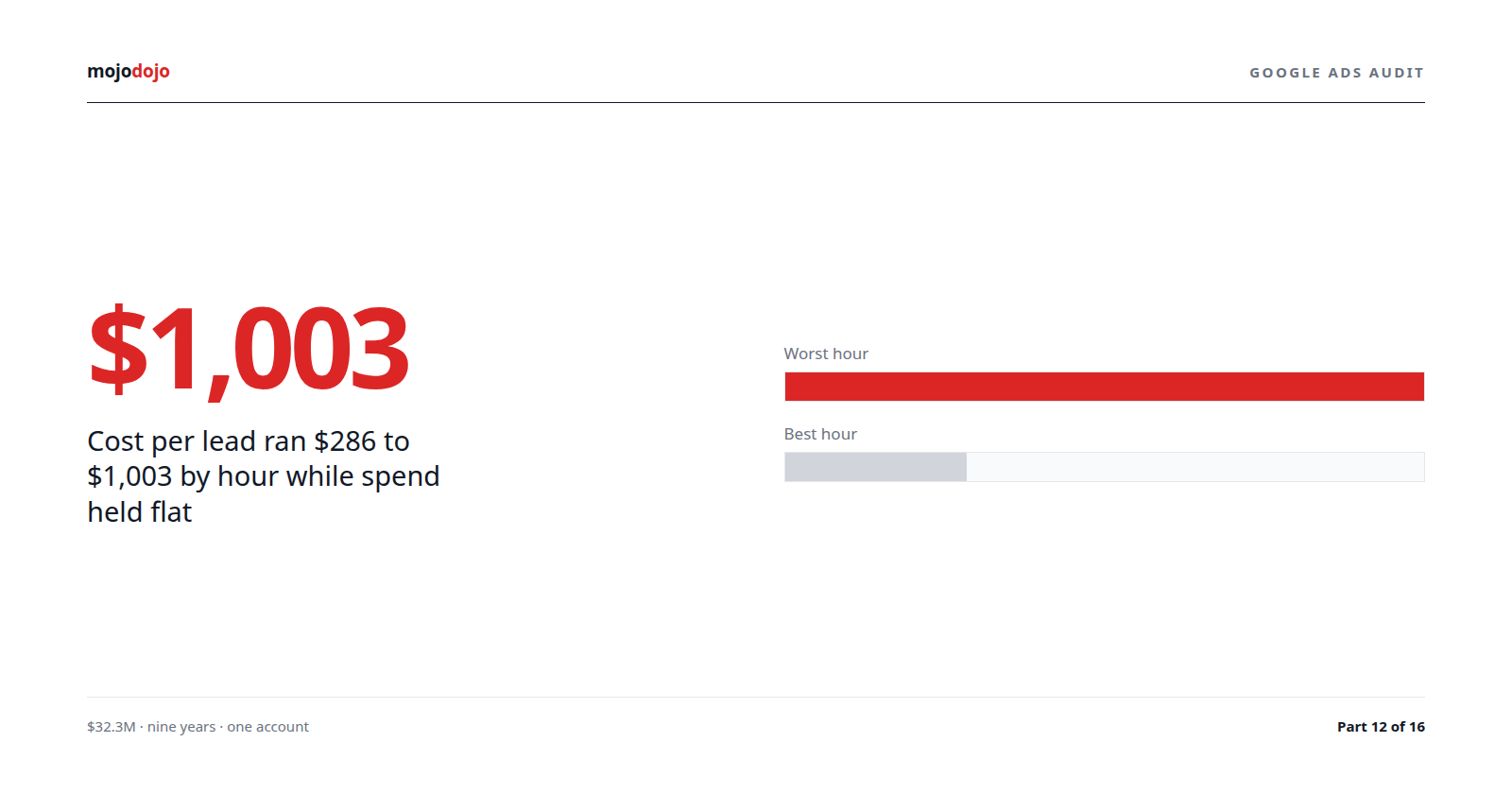
Cost per lead, deduplicated | $416 | $152 |
z-statistic | 2.60 | |
p-value | 0.0092 |
Still significant at the 1% level, with the inflation removed. Google's own experiment readout agreed:
Metric | Treatment vs control |
|---|---|
Conversions | +10% |
Cost per conversion | −67.2% |
Cost | −45.8% |
Verdict | Treatment arm won |
The experiment ran for seven days. It cost a fraction of what the restructure cost, it touched one campaign instead of sixteen, and it produced an answer with a p-value attached.
What was applied
The treatment settings were applied to the base campaign on 4 September.
Setting | Before | After |
|---|---|---|
Bid strategy | Manual CPC | Maximise Conversions |
Target CPA | n/a | $150 |
Daily budget | $1,800 | $1,800 |
Impression share lost to budget | 0% | 0% |
Conversions, trailing 30 days | 33 | 33 |
Two things worth noting about that configuration.
The target is aggressive. The campaign's trailing-seven-day cost per lead before the switch was $253. A $150 target is 41% below that. Google's own guidance is to move targets in steps of 20–30%; steeper cuts usually cost impression share. The argument for $150 is that the treatment arm demonstrably ran at $152 deduplicated on these same keywords. The argument against is that a 41% step is a 41% step. The decision was to hold at $150 and watch impression share rather than tighten further.
Thirty-three conversions in thirty days is exactly the threshold. Smart bidding wants around 30. This campaign has 33. One bad week puts it under, and if the new target throttles volume, it may put itself under. That is the strongest reason not to touch the target again for a fortnight.
What the experiment does not prove
Battery. Only battery. The panel category ($28,331 at $689 per lead), was not tested, and a separate panel experiment that was running told a different story.
Panel experiment (on a low-volume regional campaign) | Result |
|---|---|
Conversions | −66.7% |
Cost per conversion | +12.8% |
Verdict | Control arm winning |
Manual CPC was beating Target CPA on panel, at least on the campaign it was tested on. That experiment had its own problems. It was sitting on a $31-a-day campaign when the $154-a-day metro campaign was the obvious host, and it had eleven clicks in three weeks, but the direction is a warning. Battery and panel are different categories with different query mixes, and the battery result does not transfer.
The correct next step for panel is its own experiment, on the right campaign. Not an extrapolation.
What the nine days actually cost
Item | Cost |
|---|---|
Additional spend during the restructure window | $13,465 |
Leads not received vs the prior nine days | 144 |
At the prior $174 per lead, value of those leads | ~$25,000 |
Time to reach a decision the experiment reached in a week | ~3 weeks |
Against that, the experiment: one campaign, 40% of its traffic, seven days, and a decision with p = 0.009.
What the campaign looked like day by day
The base campaign through the transition: Manual CPC until 4 September, then Maximise Conversions with the $150 target:
Date | Spend | Clicks | Conversions | CPL | Impression share | Lost to budget |
|---|---|---|---|---|---|---|
28 Aug | $1,038 | 90 | 2.0 | $519 | 57% | 16% |
29 Aug | $445 | 38 | 2.0 | $222 | 74% | 7% |
30 Aug | $731 | 63 | 4.0 | $183 | 72% | 0% |
31 Aug | $624 | 54 | 3.0 | $208 | 67% | 0% |
1 Sep | $731 | 66 | 0.0 | n/a | 65% | 0% |
2 Sep | $795 | 71 | 4.0 | $199 | 71% | 0% |
3 Sep | $850 | 69 | 6.0 | $142 | 69% | 0% |
4 Sep (partial) | $610 | 39 | 2.0 | $305 | n/a | n/a |
Seven-day trailing: $5,815 spend, 23 conversions, $253 per lead. That's the figure the $150 target is being asked to beat. The daily swing ($142 one day, no conversions at all the day before), is a reminder of how little a single day tells you, and why the target shouldn't be adjusted on anything shorter than two weeks of data.
The broad-match risk that Manual CPC was hiding
One thing the switch back to automated bidding exposes. The campaign carried twelve broad-match keywords across two ad groups:
Ad group | Broad keywords |
|---|---|
Home Battery |
|
Solar Battery |
|
Under Manual CPC these were bid-capped by hand and recorded almost no spend, the search terms report over ten days showed broad match at essentially zero. Under a Target CPA strategy, the algorithm bids on whatever it believes will convert, and broad match on solar or rebate in a battery campaign is a very wide door. Nothing had come through it by day two, but it's the first place to look if the campaign's search terms start drifting after the switch.
The general version: Manual CPC hides structural problems by letting you cap them by hand. Automated bidding will find them. Audit the match types before you switch, not after.
The lesson
A bid strategy change is a hypothesis. The hypothesis "Manual CPC will outperform Target CPA in this account" was entirely reasonable to hold: the automation was learning from contaminated conversions, and manual control is the obvious response to that.
But a hypothesis is tested, not deployed. Google Ads has a built-in experiment framework that clones a campaign, splits its traffic, and reports a winner with a confidence interval. It exists precisely so that nobody has to restructure sixteen campaigns to find out whether a bidding idea works.
Approach | Campaigns touched | Days to answer | Answer quality | Reversibility |
|---|---|---|---|---|
Restructure | 16 | 9+, and still ambiguous | Confounded by five simultaneous changes | Poor, paused campaigns lose momentum |
Experiment | 1 | 7 | p = 0.009 | Complete, end the experiment |
Use the experiment. If it wins, apply it. If it loses, you've spent 40% of one campaign's budget for a week and learned something. Either way the other fifteen campaigns kept running.