
SEO for ChatGPT
Here’s the truth no one wants to say out loud: the traffic share of traditional search engines is going down. To show up in ChatGPT’s answers, you need content that’s designed to be read, understood, and reused by a machine.

Real Mojo Dojo clients, on the record.
You can’t afford to sit this one out.
Let’s be blunt: if you’re still optimising for traditional search engines (i.e. Google, Bing, etc), you’re already way behind the curve.
Who this service is for — if any of these sound like you, you’re on the right page.
You’re a brand that’s invisible in AI search.
You’re publishing content, but it’s not optimised for language models.
Your site structure might be blocking AI crawlers, or worse, cannibalising your own rankings.
You’re in a brutally competitive space.
And you’re playing the long game.
This isn’t a trend. It’s a shift.
ChatGPT has quietly (and now not-so-quietly) become a major player in how people find and interact with information across Australia. What started as a novelty chatbot is now handling billions of queries a month, with OpenAI pushing harder into search territory by the day. This isn’t a trend. It’s a shift, and it’s already changing how content is found, read, and ranked.
How AI search engines like ChatGPT work.
TL;DR — ChatGPT doesn’t search the web like Google does. To show up in ChatGPT’s answers, you need content that’s designed to be read, understood, and reused by a machine.
First and foremost, ChatGPT isn’t wasting time crawling billions of pages. Instead, it relies on two core sources:
- Pre-trained data, i.e. massive volumes of text, documents, and websites it’s already learned from.
- Live web browsing (via Bing), so that when browsing is turned on, ChatGPT fetches real-time info through Microsoft’s search infrastructure.
Second, unlike Google, which expects keywords, ChatGPT handles natural language. You don’t have to phrase things a certain way. People ask questions exactly how they talk, and ChatGPT answers accordingly.
That means content optimised for ChatGPT needs to be clear, well-structured, and conversational. If your page rambles, buries the lede, or uses jargon, AI skips it.
Third, and this is a big shift: ChatGPT doesn’t show a ranked list of 10 websites. It picks snippets of content it trusts and builds an answer around them. That means your goal isn’t just to rank, it’s to be referenced. Pages that get reused in AI answers usually:
- Explain things clearly and succinctly.
- Use clean structure (headings, bullet points, summaries).
- Sound authoritative without sounding robotic.
Last but not least, in some cases, if you’re lucky, ChatGPT will include a link or citation. But only if:
- The content is well-sourced.
- The site has clear authority.
- The formatting makes it easy for AI to extract the key info.
Don’t believe us? We dug into the numbers.
Publishers are already reporting major drops in Google traffic since AI answers started crowding the top of the page. Meanwhile, behind ChatGPT is serious money: OpenAI is valued at $90B+, backed by Microsoft, with Elon Musk launching xAI to compete head-on in the AI search race.
We nail the basics, then build content for a language model.
We’ve designed an AI SEO strategy perfectly optimised for the post-search era. We make it easy for ChatGPT to grab what it needs, and hard for your competitors to outrank you in an AI response.
Technical SEO
Site speed, crawlability, mobile responsiveness, internal linking and indexing — cleaned up by our in-house SEO team.
Content structure
Headers in the correct spots, metadata done properly, and schema markup applied where it counts.
Site speed & crawlability
So AI bots like GPTBot can efficiently access and analyse your content for citation.
Internal linking for AI
Good internal linking helps AI models understand the relationship between entities and topics on your site.
Clearly defined sections
Our content team builds your site content in a way that makes sense to a language model.
Strong summaries
40–60 words to nail the point, so ChatGPT can grab what it needs.
Consistent formatting
Clean, predictable structure that is easy for a machine to read, understand and reuse.
Internal structure
Structure that helps AI tools follow your argument from start to finish.
Get a visibility audit
A no-pressure visibility audit that shows you exactly where you stand in the AI search landscape.
Label it for machines. Prove it to them.
Schema & semantic SEO
You can’t just say what you do. You have to label it for machines. We implement rich, structured schema across your site, everything from FAQs and product schema to articles, and local business markups.
More importantly, we optimise your content for the topics and entities AI cares about, so when someone types in a natural-language query, your business is top of mind.
E-E-A-T optimisation
Experience. Expertise. Authority. Trust. Search engines and AI models are trained to look for these signals. And they use them to decide which content is credible.
We help you prove your legitimacy. That means real author bios, expert quotes, external citations, trust badges, case studies, awards — all the things that show a real business, run by real people. We also ensure your content links to reliable, first-party data or trusted third-party sources (e.g., PubMed, government sites, academic journals) to further validate your claims and enhance trustworthiness in the eyes of AI.
If Google or ChatGPT sees your content and can’t tell who wrote it, and why they’re qualified to, you’ve already lost the ranking.
AI visibility testing
We test how your site performs in the places you’re not tracking yet.
- What does ChatGPT say about your brand?
- Are your product descriptions being referenced by Copilot or Perplexity?
- Is your content surfacing in voice search results or AI summaries?
Because if the answers you should be showing up in are going to someone else, we’ll find out why, and fix it.
LLM content clustering
Think of this like feeding ChatGPT a clean, complete map of your niche. A connected web of data that makes you the obvious and most reliable answer source.
We identify the full topic footprint your site needs to cover, and we build internal content ecosystems that make it easy for LLMs to understand your authority across a subject. This helps you get quoted and cited, even if users don’t directly click on your site.
What search will look like on ChatGPT.
Curious about what search will look like on ChatGPT? Here’s the latest on recent developments.
Shopping inside ChatGPT
OpenAI has started testing native shopping inside ChatGPT with integrations from Shopify, Klarna, Instacart, and more. You can now ask ChatGPT to list gift ideas for under $50 and get AI-curated product picks.
Copilot everywhere
Microsoft is actively rolling out Copilot across Windows, Edge, Office and Bing. The kicker? They’re all powered by the same engine as ChatGPT. This means AI search is no longer confined to a chatbot, it’s showing up everywhere.
Zero-click answers
Users are increasingly gravitating toward direct, AI-generated summaries, obtaining answers directly from Google’s results page without clicking through external sites. This means more zero-click searches, which also means a gradual decline in organic traffic.
The game has evolved
Yes, you still need technical SEO. You also still need impactful content. But the game has evolved… and that’s exactly where we come in.
Organic visibility results.
Real SEO and content results from programmes we have delivered — the technical, content and authority foundations this service is built on.

ARP Engineering
292% increase in organic traffic

Three Seas Psychology
1100% increase in search volume

Salt 3
430% increase in organic traffic

Anvelo
2278% increase in organic rankings

Arise Solar
700% increase in brand searches

Inzenious
247% increase in sessions
“Their team understood our business before we even had to explain it. Enquiries are up 250% and the quality is better than ever.”
How AI engines decide which businesses to name.
A growing share of your buyers now ask ChatGPT, Gemini, Perplexity or Claude and never see a results page — how those engines decide which businesses to name, how to become one of them, and how to know if it is working.
Send me the GEO Playbook →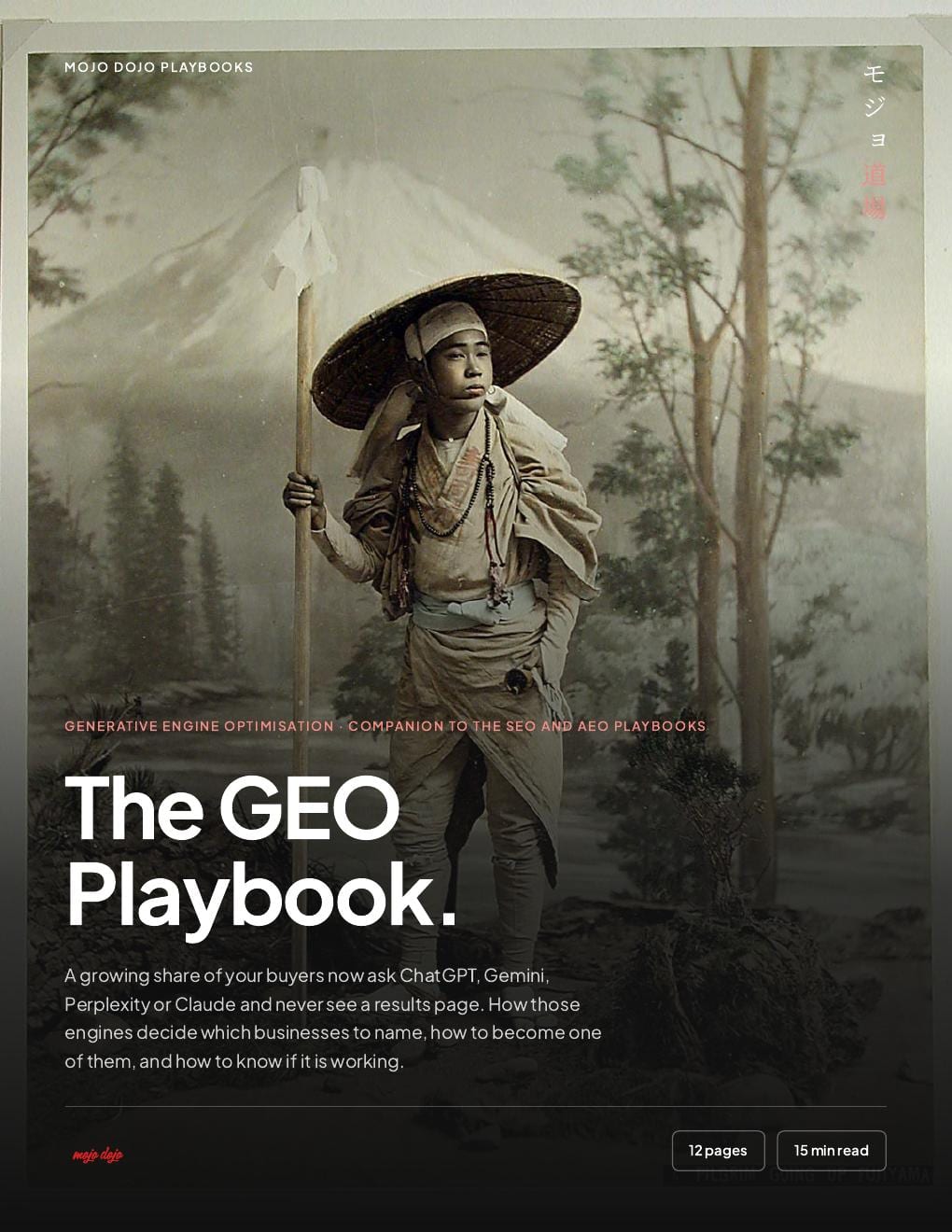
Free. 12 pages. In your inbox. Magic-link delivery — it arrives in about two minutes, and there's no sales call attached to reading it.
Will ranking on Bing guarantee visibility in ChatGPT?
Yes and no. While ranking on Bing helps, it doesn’t guarantee visibility on ChatGPT. The AI model prioritises a specific content style and structure. To get referenced, it has to be optimised for how the language model understands and interacts with the content.
If my content ranks well on ChatGPT, will it appear on other AI platforms too?
TL;DR: Optimising for one will improve your chances with all.
Each AI model has its own model and training data. Regardless, content that’s well-structured and authoritative will likely be referenced across multiple platforms.
Do AI platforms send traffic?
Yes, but not in the same way traditional search engines do.
For instance, ChatGPT sends traffic by mentioning and linking to sources within answers. It’ll also refer users to follow-up links if they want to dig deeper.
Will AI search kill SEO?
Absolutely not. BUT, it will kill bad SEO.
Keyword-stuffing and backlink chasing won’t cut it anymore. To stay visible, your content needs to be genuinely useful and well-structured.
AI still needs sources to reference. The future of SEO is about being that chosen answer.
Get your free SEO audit.
If you’re seeing signs like falling traffic or fewer clicks, let’s call it what it is: ChatGPT is revolutionising search. Submit your website and we'll send you a comprehensive audit within 48 hours. No calls, no obligations, just a clear diagnosis of your biggest SEO bottleneck.
More AI visibility & SEO services.
Everything that feeds an AI answer: the SEO foundations, the content, and the other engines.