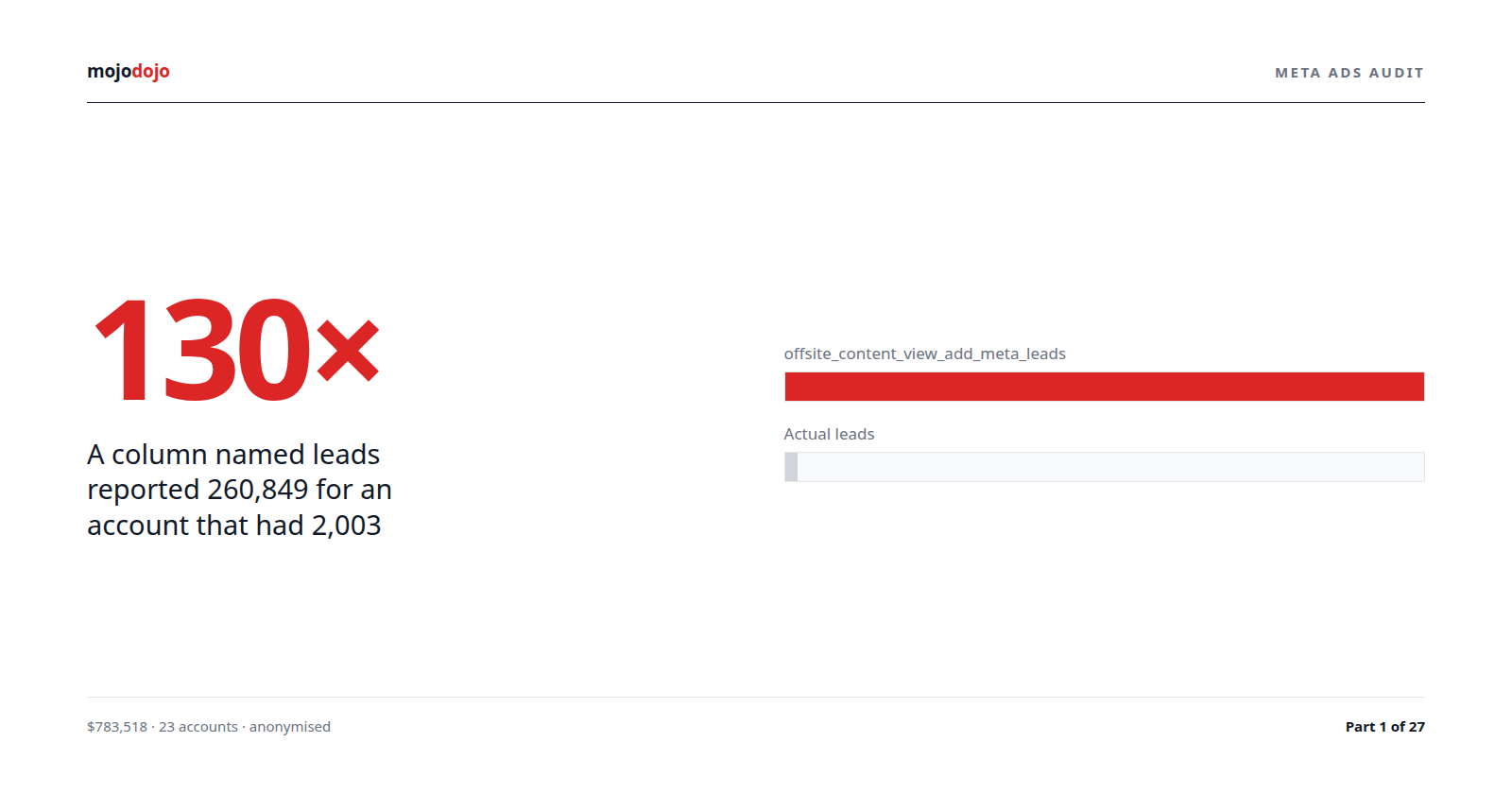


Google Ads video: $1.2M, 2,124 conversions, $567 CPL. Connected TV: $70/click, 0 conv
Every time a video campaign underperforms on cost per lead, the same explanation arrives: it's upper funnel. It builds awareness. It drives brand search later. You can't judge it on last-click.
That explanation is sometimes true. It is also unfalsifiable on any single quarter's data, which is why it survives. So here is nine years.
Channel | Lifetime spend | Clicks | Conversions | Cost per lead | Conversion rate |
|---|---|---|---|---|---|
Search | $25,740,705 | 2,313,115 | 204,755 | $126 | 8.9% |
Performance Max | $2,675,380 | 871,132 | 23,509 | $114 | 2.7% |
Display | $2,629,751 | 4,104,851 | 21,358 | $123 | 0.5% |
Video | $1,205,231 | 300,335 | 2,124 | $567 | 0.7% |
Demand Gen | $26,406 | 32,567 | 35 | $765 | 0.1% |
Video produced leads at $567. The account's blended figure is $128. That is 4.4× the average, sustained over $1.2M and nine years.
The brand-lift test that nine years provides
If video builds brand, the effect should show up somewhere. The obvious place is brand search volume: people who saw the ads and later searched the name.
The account's brand search campaign has run continuously since 2018. Brand conversions as a share of the account's total have stayed in a band around 26–30% for the whole period. There is no inflection in brand search that lines up with periods of heavier video spend. The video campaigns ran, the brand searches came in at roughly the rate they would have anyway, and the video leads cost $567.
That's not a rigorous causal test. But "upper funnel" is a claim about a downstream effect, and nine years is long enough for a downstream effect to appear. It didn't.
If video were building brand, you'd expect | What the account shows |
|---|---|
Brand search volume rising after video pushes | Flat share, no inflection |
Brand CPL falling as awareness grows | Stable at ~$50 throughout |
Video-exposed users converting later via search | Not measurable in this account; not visible in brand trend |
Connected TV made it worse
The ten-day device report turned up something small and specific:
Device | Spend | Clicks | Conversions | Cost per click |
|---|---|---|---|---|
Connected TV | $2,758 | 39 | 0 | $70.72 |
All from three YouTube campaigns. Seventy dollars per click, on a screen that has no keyboard and no reasonable path to a form submission. Thirty-nine people clicked something on their television and none of them became a lead, which is about what you'd expect from someone clicking something on their television.
Campaign | CTV spend | Clicks | Conversions |
|---|---|---|---|
YouTube, main state | $2,193 | 39 | 0 |
YouTube, second state | $438 | 0 | 0 |
YouTube, third state | $127 | 0 | 0 |
Connected TV is on by default for video campaigns. It is one checkbox to exclude. It had been costing about $275 a day.
The honest counter-argument
Last-click attribution is unkind to anything that isn't the final step. A video view that leads to a search that leads to a form is credited entirely to the search. Video's real contribution is understated by design.
True. And here is why it doesn't rescue the channel in this account:
Objection | Response |
|---|---|
"Last-click undercounts video" | Data-driven attribution was available and applied on the main conversion actions. Video's CPL under DDA was still several multiples of search |
"It builds brand over time" | Nine years is enough time. Brand search didn't move |
"The audience is different, it's prospecting" | Then it should show up as new brand searchers or new-to-account converters. It didn't |
"You need to give it a proper budget" | $1.2M is a proper budget |
At some point, "it's upper funnel" stops being an explanation of the data and becomes a reason not to look at it.
What video is for
None of this means video is useless. It means video was being bought as a lead-generation channel and judged as one, and on those terms it failed for nine years.
Use of video | Reasonable expectation | Judge it by |
|---|---|---|
Remarketing to site visitors | Modest CPL, small volume | Cost per lead, with a real bar |
Prospecting for direct response | High CPL | Cost per lead, and if it's 4× search, stop |
Brand awareness | No direct leads | Brand search volume, aided recall, not CPL |
Product education / launch | No direct leads | Views, watch time, later search lift |
The failure was not running video. It was running it under a lead-gen budget line with a lead-gen KPI, then explaining the result with an awareness argument nobody was measuring.
What to do
Give every channel a cost-per-lead bar it has to clear, including the ones defended as brand-building. If a channel is genuinely upper-funnel, measure the upper-funnel effect (brand search volume, branded query share), and set a bar on that instead. Either way, there is a number.
Exclude Connected TV from any video campaign with a lead-gen objective. Today.
And if a channel has had nine years and $1.2M to demonstrate a downstream effect and hasn't, the defence has been tested. It failed. Move the money to the channel producing leads at $114.