

US ChatGPT ad visits earned US$0.89 vs US$2.45 for paid search
In US traffic, each ChatGPT ad visit returned US$0.89 in revenue and each paid Google search visit returned US$2.45, a working paper by Maximilian Kaiser of the Vienna University of Economics and Business and Christian Schulze of the Frankfurt School of Finance and Management has found.
The paper is dated October 2026 and is under review. It tracks site visits and sales as OpenAI launched ChatGPT Ads market by market, and draws its paid-ad results from 102 advertiser sites that had complete sales tracking.
ChatGPT Ads has run in Australia since April 2026, so Australian advertisers are now deciding whether to run a test. OpenAI's ads FAQ says ChatGPT Ads "does not yet have performance benchmarks across advertisers, industries, or campaign types", which leaves advertisers with little to check a proposal against.
ChatGPT ad conversion rates against paid search
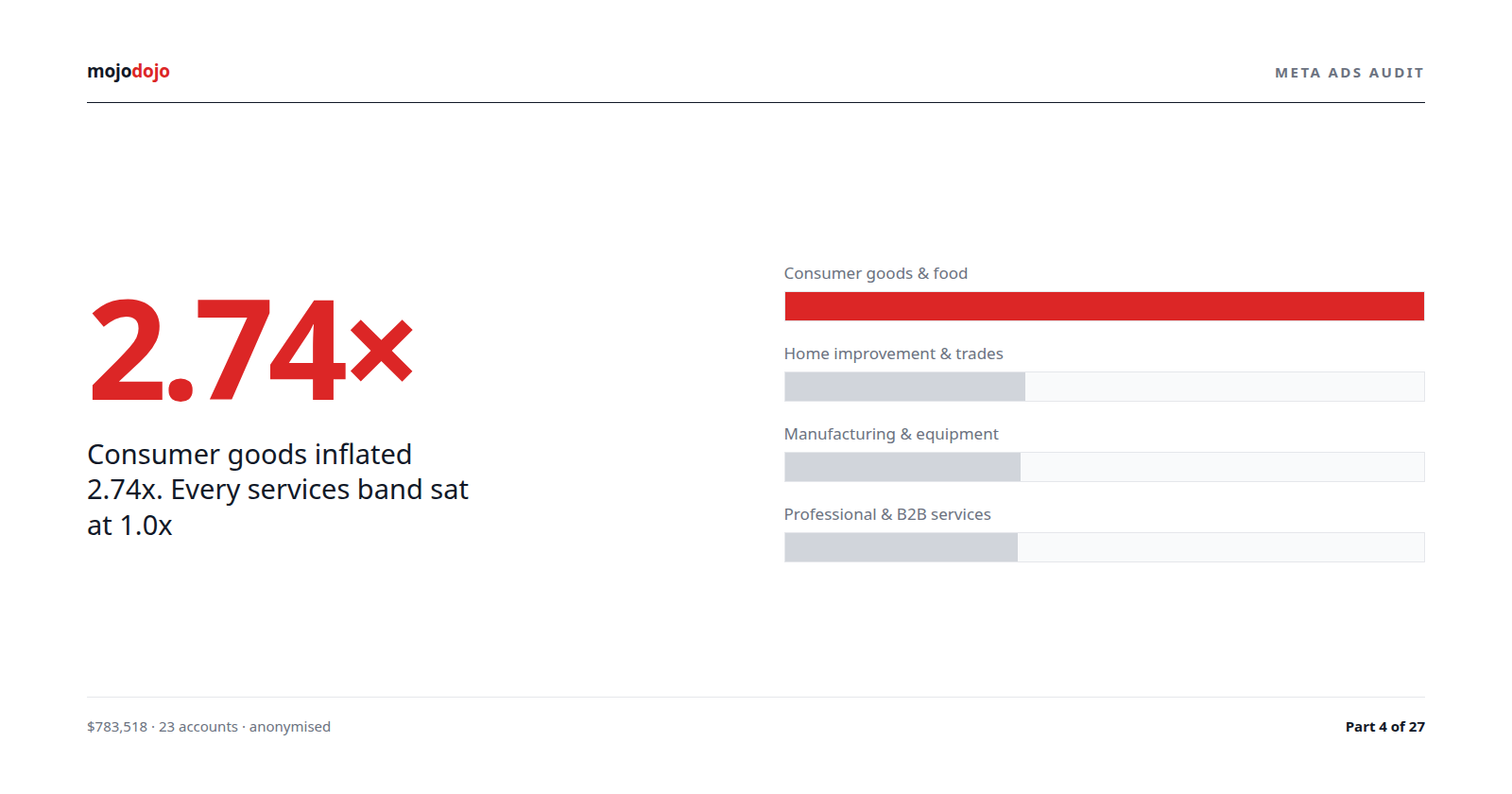
ChatGPT ad visits converted at 0.37% in US traffic. Paid search visits converted at 1.17%. The gap held when the authors compared both channels within the same websites and adjusted for device type and week.
Of the 87 advertisers that bought both ChatGPT ads and paid search in US traffic, 84 earned less per ChatGPT ad visit than per paid search visit. Seventy-three of them recorded no sales at all from ChatGPT ads, across 18,726 visits between them. The other 14 produced every one of the 570 purchases attributed to ChatGPT ads.
Search click costs suggest ChatGPT clicks are worth about US$0.26
The authors measure ChatGPT against paid search using what they call a parity price: the most an advertiser could pay per ChatGPT click and still get as much revenue for each ad dollar as paid search delivers.
The authors' cost data held 16 accounts that drew at least 80% of their paid search traffic from the US, and the median search CPC across them was US$0.72. Scaled by the difference in revenue per visit, that gives roughly US$0.26 per ChatGPT click.
The estimate is wide. One advertiser accounted for 76% of all US paid ChatGPT revenue, and when the authors resampled the advertisers, 95% of the parity estimates fell between US$0.05 and US$0.57.
A reported US$1.72 click is over six times the parity price
OpenAI's help page for ChatGPT Ads recommends starting CPC campaigns with a maximum bid of US$3 to US$5 per click. The paid media agency Opascope has reported one account paying US$1.72 a click over 15 days of spend, more than six times the parity price in the paper.
Ads are sold through a relevance-weighted second-price auction, so the maximum bid caps what an advertiser pays and the auction sets the actual charge. Advertisers can buy on impressions (Views), clicks (Clicks) or conversions, and conversion-optimised campaigns with click billing are charged per valid click.
CPC bidding is fairly new. OpenAI sold ChatGPT ads on a CPM basis in the first phase of its pilot. In May 2026 it added CPC bidding and began rolling out a beta self-serve Ads Manager, shortly after launching a Conversions API and pixel-based measurement. Ads Manager reporting covers impressions, clicks, spend, CTR, average CPC, average CPM and conversions.
Revenue and conversion figures cover US traffic only
The first ChatGPT ads went live in the United States on 9 February 2026. Australia, Canada, New Zealand, the United Kingdom, Japan, Korea, Brazil and Mexico followed by early August. The European Union did not get ads until 24 August, two days after the paper's 60-week data window closed on 22 August.
The revenue and conversion figures cover US traffic. There is no Australian breakdown.
Grips Intelligence, an ecommerce data company, gave the authors free access to the Google Analytics ecommerce tracking behind the study. Kaiser previously worked at Grips and is now a scientific advisor to it. According to the paper, Grips took no part in the research and has no commercial ties to OpenAI.
The data set records the last click before each visit. It does not include prompts, ad impressions or the user's subscription tier. Advertisers chose to buy ChatGPT ads, so the comparison shows what those advertisers got, and it cannot show that the ads caused the result.
Other published results are more favourable, though they use different measures. OpenAI said on 31 August that one ecommerce advertiser recorded a return on ad spend of three times its spend over 28 days.
Since the data window closed, OpenAI says ChatGPT Ads has expanded to 89 countries, more than 100,000 advertisers have run campaigns, and CPC and outcome-optimised bidding make up most of them. The mix of advertisers in the paper may not match the mix today.
Sites received fewer organic ChatGPT referrals
To test whether ads made ChatGPT less useful, the authors tracked unpaid ChatGPT referrals to 1,898 sites. Measured against organic search referrals to the same sites, and using the EU (where no ads ran) as the comparison, ChatGPT referrals fell an estimated 5.9% in the 13 weeks after launch. The uncertainty range ran from a 12.6% fall to a 1.2% rise, so no change cannot be ruled out.
Once the authors allowed for faster ChatGPT uptake in North America than in Europe, using OpenAI's regional adoption index, the estimated fall became 7.2% to 8.4%, and those ranges exclude zero. The authors describe the overall effect as a moderate decrease of roughly 6% to 8%.
For a site that already gets ChatGPT referrals, this sits alongside the paid question. AI assistant referral traffic came in under 3% of organic search traffic in two analyses covering 195 sites, so a 6% to 8% dip in it will rarely show up in revenue, though it is worth a look in analytics.
Where do ChatGPT ads appear and who sees them?
ChatGPT ads appear below the response as a card with the advertiser name, logo, headline, description, image and landing page, according to OpenAI's help page. OpenAI's January 2026 post setting out its ads principles says ads do not influence answers and are always separate and clearly labelled, and that during its test ads would not be eligible to appear near sensitive or regulated topics such as health, mental health or politics. OpenAI's ads site pitches the placement as reaching people "as they explore options, compare alternatives, weigh tradeoffs, and make informed decisions".
Ads show only on the free and Go tiers, never to Plus, Pro or Business accounts or to users identified as under 18. Advertisers guide matching with context hints set at ad group level, which describe the conversations or topics where a product might be relevant; OpenAI's system also weighs the conversation itself and the ad's landing page and copy. OpenAI says these are not exact-match keywords and do not guarantee delivery. That is a different model from the keyword auction Australian advertisers know from Google Ads, and from ads in AI Mode, which Google serves from existing Search, Shopping and Performance Max campaigns.
Calculate your parity CPC from paid search revenue data
The parity price is easy to compute for any account that already runs paid search with revenue tracking. Take your revenue per ChatGPT ad visit, divide it by your revenue per paid search visit, and multiply the answer by your average search CPC. That figure is the click price at which each dollar spent on ChatGPT ads would bring in as much tracked revenue as a dollar spent on search. It does not count profit margins or purchases made on a later visit, so use it to anchor a test budget rather than as a final answer.
A few steps keep the comparison fair:
- Add UTM parameters to ChatGPT ad landing page URLs. OpenAI says they persist on ad clicks, so sessions land in analytics under a source you can isolate.
- Filter out ad-review crawler visits. OpenAI's help page says its ad-review crawlers may visit submitted landing pages with the tracking parameters attached, and third-party analytics can classify those visits as paid traffic. They are not billable clicks, but left in they inflate the visit count and drag down revenue per visit.
- Allow for reporting lag. Impressions, clicks and CTR refresh roughly every 15 minutes, but spend can be delayed seven to eight hours, so a displayed spend of zero does not mean nothing has been charged.
- Give the test enough clicks. At a 0.37% conversion rate, 1,000 clicks yields fewer than four purchases, which cannot separate a good channel from a bad one. The same maths that governs A/B test sample sizes in Google Ads applies here.
- Start the maximum CPC at or near your parity price. OpenAI suggests US$3 to US$5, and a low ceiling may limit delivery, which Ads Manager's bid-strength guidance may flag.
If paid search already pays its way, take the parity price into the conversation with whoever is proposing a ChatGPT test, and read the first fortnight of data with the crawler visits removed.