
Meta Ads: 216 campaigns chose LINK_CLICKS in 2023 and 2024, after outcome objectives existed
Of the 1,134 campaigns built across 23 Australian Meta Ads accounts since 2013, 115 created in 2023 and 101 created in 2024 carry the LINK_CLICKS objective. A further 27 have been built with it since. That is 243 campaigns choosing a legacy objective after Meta's outcome objectives had replaced it. Pooled lifetime spend across the 23 accounts is $783,518 AUD; this post is about counts, because the pull does not attribute spend to objective and we will not guess at it.
The timing is the finding. Meta's outcome-driven objectives, the six OUTCOME_* options, rolled out through 2022 and became the only choice for a new campaign in Ads Manager during 2023. Legacy objectives stayed creatable through the API and through some third-party tools. So a LINK_CLICKS campaign dated 2023 or 2024 is not an old campaign wearing an old label. It is a choice someone made, or a tool made for them, after the alternative was the default in front of them.
We pulled objective and created_time for every campaign. The table shows the nine objectives the pull breaks out, by year of creation, from 2018 onward. The earlier years hold 45 campaigns between them and are omitted for space; the totals column is the full count for each year, so rows do not sum across, because the pull does not break out every objective.
Created |
|
|
|
|
|
|
|
|
| Total |
|---|---|---|---|---|---|---|---|---|---|---|
2018 | 38 | 1 | 13 | 0 | 0 | 6 | 2 | 0 | 0 | 62 |
2019 | 45 | 21 | 13 | 3 | 5 | 9 | 2 | 0 | 0 | 102 |
2020 | 15 | 63 | 4 | 1 | 1 | 11 | 13 | 0 | 0 | 122 |
2021 | 16 | 27 | 1 | 5 | 4 | 5 | 2 | 0 | 0 | 63 |
2022 | 48 | 14 | 4 | 3 | 2 | 0 | 2 | 9 | 8 | 96 |
2023 | 115 | 3 | 0 | 13 | 3 | 0 | 1 | 16 | 3 | 165 |
2024 | 101 | 1 | 5 | 5 | 25 | 1 | 2 | 11 | 9 | 192 |
2025 | 17 | 1 | 3 | 2 | 4 | 2 | 0 | 12 | 21 | 114 |
2026 | 10 | 0 | 0 | 7 | 2 | 4 | 0 | 22 | 41 | 173 |
Read the LINK_CLICKS column top to bottom. It was the main objective in 2018 and 2019, gave way to CONVERSIONS in 2020 when the pixel era peaked at 63 campaigns, then came back: 48 in 2022, 115 in 2023, 101 in 2024. The year the outcome objectives took over the interface is the year LINK_CLICKS had its busiest year in the set. Meanwhile CONVERSIONS, the objective that actually asked for a lead or a sale, collapsed from 63 to 3.
The shift to outcome objectives finally shows up in 2025 and 2026: OUTCOME_TRAFFIC at 21 then 41, OUTCOME_SALES at 12 then 22, LINK_CLICKS down to 17 then 10. But note what OUTCOME_TRAFFIC is. It is the same decision under the new name.
What LINK_CLICKS actually optimises for
An objective in Meta is a promise about what the ad set underneath it will bid for. The legacy objectives mapped onto the outcome ones roughly as follows, and the mapping is the point: the labels changed, the optimisation events did not.
Legacy objective | Outcome objective it became | What the ad set bids for |
|---|---|---|
|
| People likely to click, or to load the landing page |
|
| People likely to fire a pixel event |
|
| People likely to submit an instant form |
|
| People likely to start a conversation |
|
| People likely to react, comment or share |
|
| Unique people, as many as possible |
|
| People likely to watch |
Under a LINK_CLICKS or OUTCOME_TRAFFIC campaign, the ad set's optimisation goal is normally LINK_CLICKS and occasionally LANDING_PAGE_VIEWS. Part 13 counted those across the 538 ad sets with a targeting object: 77 optimise for link clicks, 21 for landing page views. The difference between the two is the whole difference between buying a click and buying a visitor. Optimising for the click means Meta finds the people most likely to tap. It does not care whether the page loads, whether the pixel fires on it, or whether anyone fills in anything. The click is the end of its job.
Optimisation goal | Bids for | Knows the page loaded | Knows a lead happened |
|---|---|---|---|
| The outbound click | No | No |
| The pixel's PageView on the destination | Yes | No |
| A named pixel event | Yes, implicitly | Yes |
| An instant form submission | Not applicable, the form is in-app | Yes |
Why did it keep being chosen? The pull records the objective and the creation date, not the tool that created the campaign or the reasoning behind it, so what follows is mechanism rather than measurement. Three reasons fit the data. First, a conversion objective needs a pixel event to optimise toward, and part 27 shows five of these accounts have no pixel events at all and four more have weak ones; for those accounts, traffic is the objective that will run. Second, a traffic campaign produces the cheapest visible result and exits the learning phase fastest, because clicks are plentiful and Meta's own guidance asks for around 50 optimisation events a week. Third, some of these campaigns will have been created by tools or duplicated from older campaigns that carried the legacy objective forward. None of those reasons makes the click the right thing to buy.
What it does to decisions
The cost of a click objective is not the click. It is what happens after it, and the objective is indifferent to that by design.
Part 27 measured the gap. Across the pooled set, 733,847 paid link clicks produced 445,245 landing page views: 39.3% of clicks never registered a page load. Split by pixel evidence:
Group | Link clicks | Landing page views | Drop-off |
|---|---|---|---|
Pixel firing | 651,427 | 424,001 | 34.9% |
Weak pixel evidence | 35,322 | 18,804 | 46.8% |
No pixel events | 47,098 | 2,440 | 94.8% |
Pooled | 733,847 | 445,245 | 39.3% |
The bottom row is mostly a measurement gap: no pixel, no landing page view, whatever happened. The top row is not. Accounts with a working pixel still lost 34.9% of their paid clicks before the page registered. The pull does not cross-tabulate that drop-off by objective, so we cannot say the click campaigns lost more than the lead campaigns. What we can say is that a click objective is the only objective that would not notice if they did. A LANDING_PAGE_VIEWS goal is bidding for the event on the far side of that gap. An OFFSITE_CONVERSIONS goal is bidding for the event two steps past it. A LINK_CLICKS goal stops at the near side and reports success.
That interacts with placements. Part 18 showed Audience Network clicks at $0.32 with a 15.2% landing rate, against Facebook Feed at $0.72 and 35.6%. An ad set that is bidding for the cheapest click, with placements left automatic, is being pointed at the inventory where clicks are cheapest and land least. The two settings are individually defensible and jointly expensive.
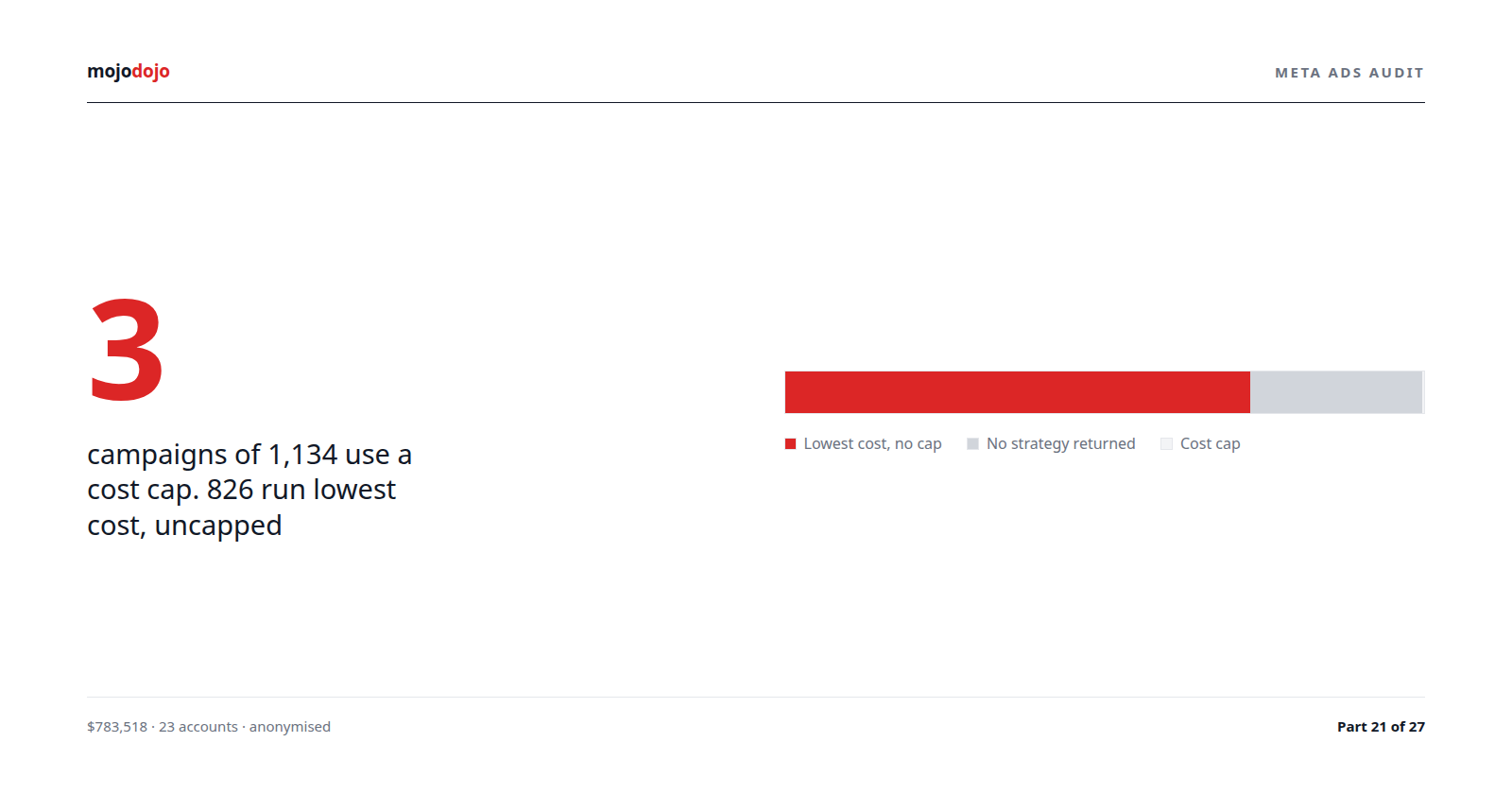
It also shows up in reporting. A traffic campaign's headline number is cost per link click, which will look excellent next to a lead campaign's cost per lead, because they are not the same unit. Within an account, that is part of how the 430x campaign spread in part 19 gets built: a campaign that was never bidding for leads still records the leads that happen to occur, and its cost per lead is whatever accident produced them. And it feeds the next post. A campaign that buys clicks at lowest cost with no cap, which part 21 will show is the setting on 826 of the 1,134 campaigns, is a campaign with no stated limit on what it will pay for an event that has no stated value.
Where it varies
The pull does not split objective by band or by account letter for this cut, so the variation we can show is across time. The column that matters is click-buying under either name.
Created |
|
| Click objectives combined | All campaigns | Share |
|---|---|---|---|---|---|
2022 | 48 | 8 | 56 | 96 | 58.3% |
2023 | 115 | 3 | 118 | 165 | 71.5% |
2024 | 101 | 9 | 110 | 192 | 57.3% |
2025 | 17 | 21 | 38 | 114 | 33.3% |
2026 to 9 Sep | 10 | 41 | 51 | 173 | 29.5% |
The combined column and the share are ours, summed and divided from the pull's counts. In 2023, seven in ten campaigns built across these accounts were built to buy clicks. In 2026 so far it is three in ten, and the majority of those now use the new label. The label migration is nearly complete. The decision migration is about half done: 51 of this year's 173 campaigns are still traffic campaigns, and 2026 is already the second-busiest build year in the set.
The other movement worth noting is MESSAGES, which jumped to 25 campaigns in 2024. Parts 5 to 7 covered what a messaging conversion is and is not. A messaging objective is a step up from a click objective in that it at least asks for a human action on the far side of the ad; it is a step sideways in that the action it counts is often a welcome message view or a block.
What to check in your account
Ads Manager, campaign level, add the Objective column and filter to campaigns created since 1 January 2023. Count how many say Traffic or Link clicks. Those are the ones this post is about.
For each, open the ad set and read the optimisation goal under Performance goal. Link clicks means the campaign stops caring at the tap. Landing page views means it at least waits for the page.
Add the Link clicks and Landing page views columns to the same view and divide. If your pixel is working and the ratio is anywhere near the 34.9% loss from part 27, you are paying for a lot of taps that went nowhere, and a click objective will keep buying them.
Ask what each traffic campaign is for. If the answer involves a lead, an enquiry or a sale, the objective is wrong. Rebuild it under Leads or Sales with the pixel event or instant form as the goal. If the pixel is missing or weak, fix that first; a conversion objective without an event to optimise to is worse than a traffic one.
If a traffic campaign genuinely exists to send visitors to content, change its optimisation goal to landing page views and exclude the placements where clicks do not land. That is the smallest change that makes the objective honest.
Then read the bid strategy, which is the next post. Choosing an objective decides what Meta buys; the bid strategy decides what it is allowed to pay. Both defaults are worth questioning, and rebuilding both is something we do early in our Meta Ads work for Perth businesses on any account with a traffic campaign that is meant to produce leads.
The principle
An objective is an instruction, and Meta follows instructions precisely. Tell it to buy clicks and it will buy the cheapest clicks it can find, from the people most likely to tap, on the inventory where tapping is easiest, and it will call that success. Nothing in the platform will point out that the page did not load or that nobody enquired, because nothing in the platform was asked to care. The interface changed the name of that instruction in 2022. It did not change what the instruction does, and in these accounts it did not change how often it was given.